

iOS Native Development
SwiftUI applications deeply integrated with the Apple ecosystem for fluid, native-grade performance.
Native iOS and Android, or one React Native codebase across both — built to platform conventions, shipped to the stores by us, and held to a real performance budget after launch.
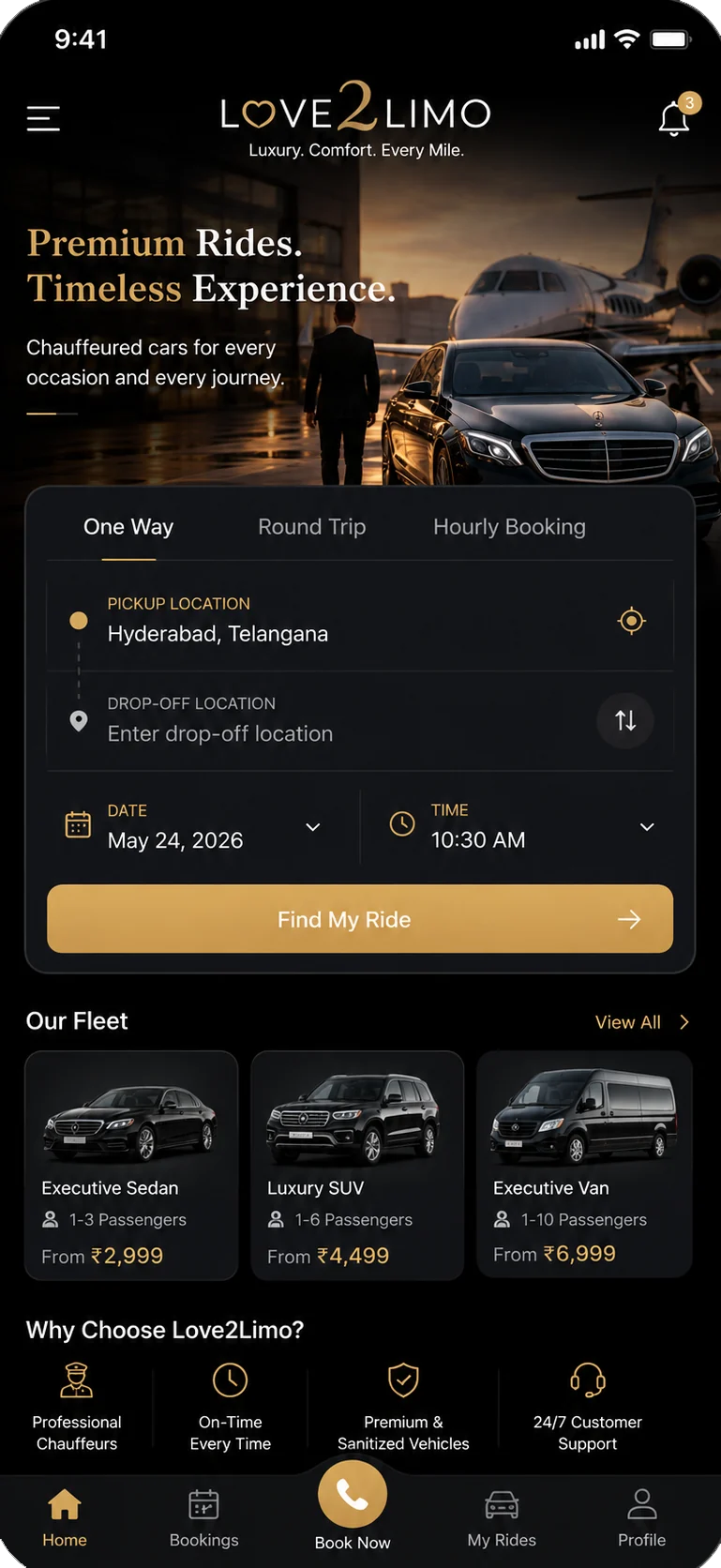
Love2Limo · Chauffeur booking
Which of these is right depends on your product, not on what we prefer to write. The comparison below is the honest version.
SwiftUI applications deeply integrated with the Apple ecosystem for fluid, native-grade performance.
Kotlin Jetpack Compose apps utilizing Material Design 3 and all Android hardware APIs natively.
Single codebase apps hitting 90%+ of native performance at dramatically reduced development cost.
Keyword research, screenshot design, and metadata engineering for maximum organic App Store visibility.
Most agencies answer this with whatever they staff. Here is how the choice actually breaks down by what you are building.
Our default is React Native or Flutter — because most products are business logic in a good interface, and a single codebase is cheaper to build and far cheaper to keep alive. We recommend native when the product genuinely needs it, and we will tell you which one you're in before you commit budget.
Launch is the start of the cost, not the end of it. A web app you can patch on a Tuesday afternoon; a mobile app has a review queue, a store rollout, and a long tail of users who never update. Budgeting the build without budgeting twelve months of releases behind it is the single most common way app projects quietly fail.
Test on the phone your users actually own. Demos on a current flagship hide almost everything that matters — a mid-range Android with three years of accumulated apps is the honest test surface. Our performance budget is measured there, which is why the cold-start target above says under two seconds rather than a number that only holds on new hardware.
Apple and Google conventions are not interchangeable. Android has a system back gesture and Material navigation; iOS has edge-swipe and its own sheet behaviour. Shipping one interaction model to both is the fastest way to make an app feel foreign on at least one platform, and reviewers notice it before your users do.
App Store Optimization belongs in the build, not after it. Screenshots, the first three words of your title, and the subtitle drive installs harder than anything you can do post-launch. We design the store listing alongside the product rather than assembling it the week of submission.
These are commitments measured on real devices after launch, not benchmarks from a simulator on a fast machine.
Time to first interactive frame on a mid-range Android device, not a flagship.
Frame budget held through list scrolling, navigation and animation.
The threshold we hold post-launch, tracked in Crashlytics from day one.
Compatibility patches shipped within a month of each major iOS/Android release.
Platform-specific animations, haptics, and navigation patterns that feel completely native to each OS.
Threading optimization, lazy loading, and memory management ensuring butter-smooth interactions always.
Keychain storage, certificate pinning, jailbreak detection, and biometric authentication built in.
Firebase, Mixpanel, or Amplitude instrumentation giving you full behavioral analytics from day one.
User journey mapping, competitive app analysis, and low-fidelity wireframing to define the core experience.
High-fidelity Figma prototypes built to platform Human Interface and Material Design guidelines.
Two-week sprints with TestFlight/Internal Testing builds delivered after each sprint for live feedback.
App Store / Play Store submission handled end-to-end with ASO, screenshots, and review management.
Indicative ranges. The real quote depends on screen count, backend scope and how many third-party systems have to be integrated.
A focused, launchable v1 on one or both stores — the smallest product that can honestly test demand.
A complete application with backend, third-party integrations, analytics and a real design system behind it.
A standing squad shipping continuously after launch — features, OS compatibility and store releases.
Async by default — a written update and an installable build at the end of every sprint, so progress is visible without a standing call.
Hyderabad-based team. UPI, Razorpay and Aadhaar-adjacent KYC flows built many times over.
Overlap held through US mornings. Stripe, Plaid and HIPAA-conscious builds.
GDPR-first data handling, Open Banking integrations and UK App Store compliance.
Arabic RTL layouts treated as a first-class design pass, not a translation afterthought.
Near-full working-day overlap with IST — the easiest timezone we serve.
Async-first delivery: written updates and a build to open, not a 6am standup.
For graphics-intensive apps (gaming, AR, video processing), go Native. For 90% of business logic applications — fintech, e-commerce, delivery, social — React Native or Flutter offers near-identical performance at half the budget.
Send the idea and the constraints. We'll come back with a platform recommendation, a screen estimate and a realistic timeline — before any contract.
Typical reply within one business day